Introduction
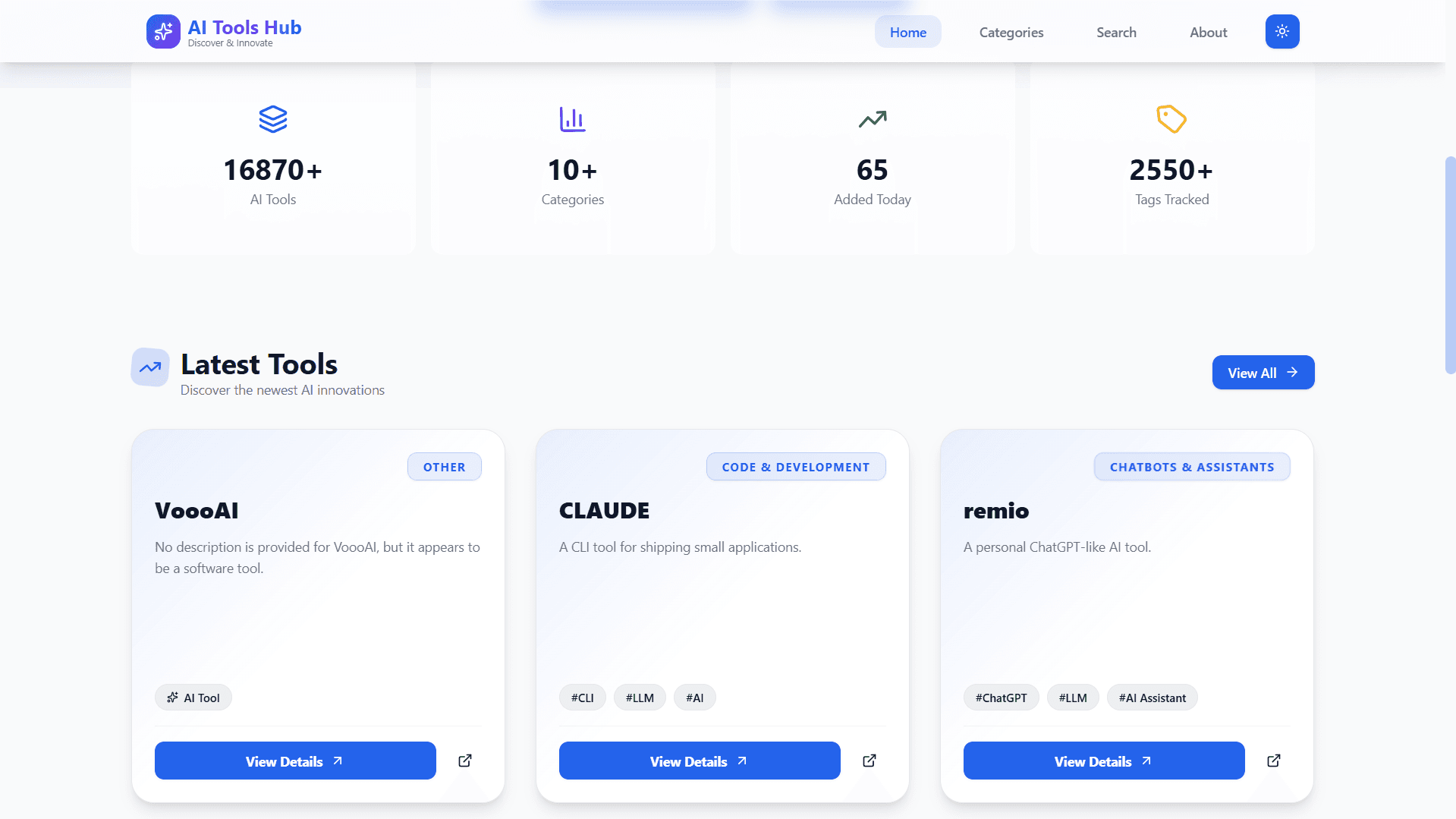
AI Tool Hub started as a question: what would a discovery platform look like if it autonomously crawled, deduplicated, and categorized the entire ecosystem of new AI tools in real time? The product is a centralized intelligence hub featuring an automated multi-source scraping orchestrator, LLM-powered categorization, and intelligent cross-domain deduplication, deployed natively across web and Android.
The problem with manual directories
Existing AI tool directories rely heavily on manual submissions or static, curated lists. They cannot autonomously ingest tools from disparate global sources, do not inherently resolve duplicated entries across different aggregators, and lack a unified method for organizing rapidly expanding categories. For someone trying to stay on the bleeding edge of AI, that is the inverse of useful.
A discovery platform should crawl the internet, deduplicate the noise, and structure the intelligence autonomously before a user ever searches for it. Anything less is just an outdated bookmark manager.




Architecture
I engineered a fully autonomous, hourly data collection pipeline managed by a centralized scrape-orchestrator Supabase Edge Function. This orchestrator delegates tasks to specialized worker functions that extract real-time updates from disparate sources including GitHub, HackerNews, HuggingFace, ProductHunt, and YouTube. On top of this sits an intelligent ingestion layer leveraging fuzzy name matching and domain comparison to mathematically guarantee zero duplication across the ecosystem.
The data normalization process is powered by a dedicated LLM utility that autonomously categorizes incoming tools and standardizes their metadata before insertion. The resulting structured intelligence is indexed in PostgreSQL using custom full-text search RPC functions, exposing sub-millisecond query capabilities to the React frontend and the Capacitor-compiled Android application simultaneously.
What I prioritized
A few of the technical decisions that mattered most:
- Autonomous Ingestion. A fleet of Supabase Edge Functions orchestrated to scrape multiple distinct platforms simultaneously on a strict hourly cron schedule.
- Intelligent Deduplication. Algorithmic URL matching, fuzzy logic, and domain cross-referencing to eliminate redundant tools fetched from overlapping aggregators.
- LLM-Powered Categorization. Leveraging AI to automatically read tool descriptions and sort them into a standard taxonomy without human intervention.
- Cross-Platform Native Deployment. Utilizing Capacitor to wrap the responsive React/Tailwind web interface into a native Android APK from a single codebase.