Introduction
If you've ever set a seed in a random number generator, you probably assumed that running the code tomorrow would yield the exact same dataset. You deploy the script to production, run it on a Linux server, and suddenly, the numbers drift. A value that was 0.4321 on your Windows laptop is now 0.4322 on the server. Your pipeline outputs diverge, downstream metrics shift, and your reproducibility guarantee is broken.
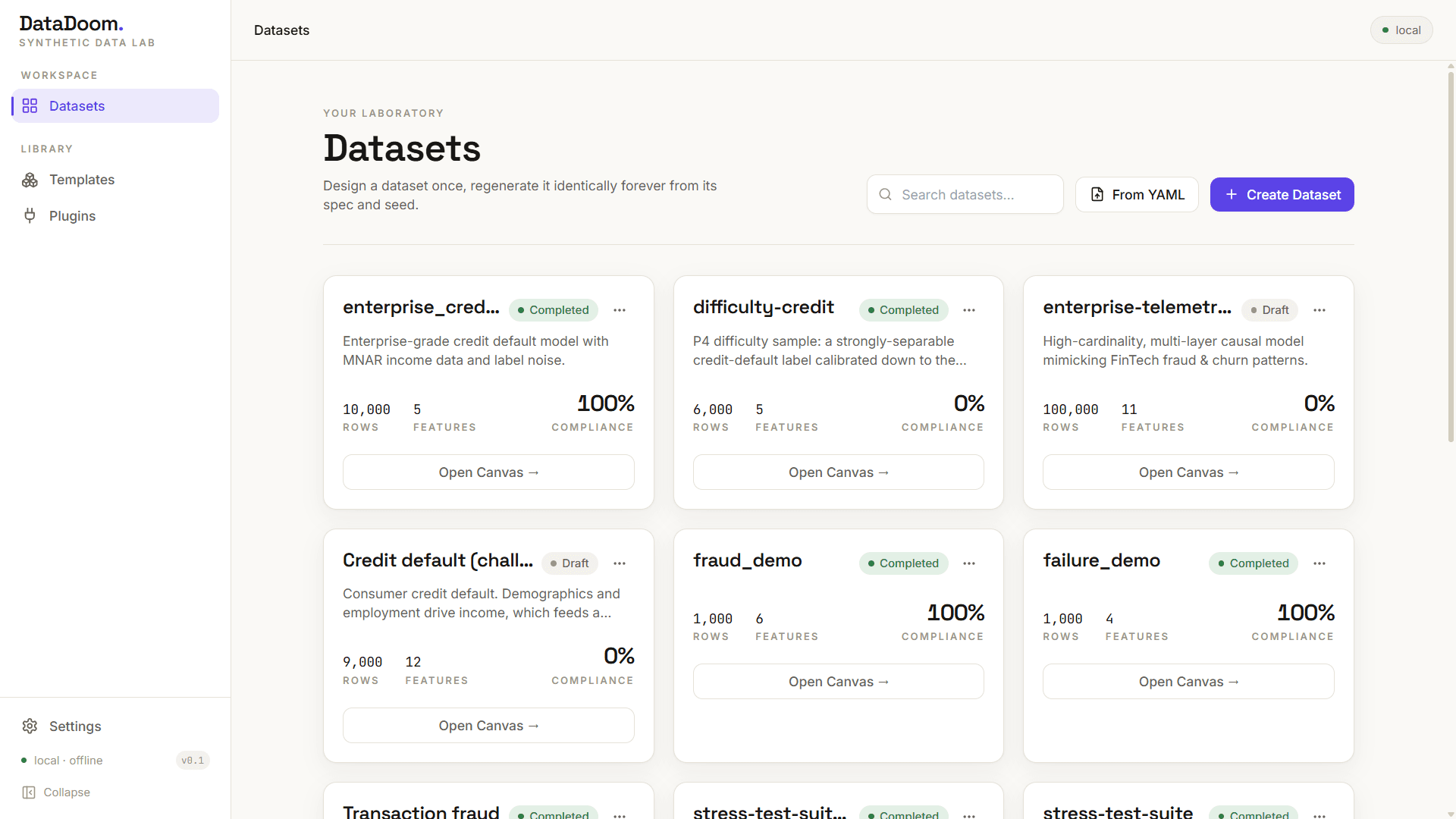
When I was building DataDoom, a local-first engine for controllable, reproducible synthetic data, I realized that standard determinism is a lie. The theoretical deep dive here isn't just about setting a seed; it's about the physics of floating-point arithmetic and structural equation networks.
The Fragility of Shared Random Streams and IEEE-754 Drift
Most developers achieve determinism by calling np.random.seed(42) at the top of their script. This is highly fragile. First, the random stream is global and shared. If a library or thread makes a single unscheduled draw, every subsequent value shifts. Second, and more insidiously, floating-point arithmetic is not associative due to the IEEE-754 standard. Small variations in how a CPU compiler optimizes additions or divisions, combined with minor differences in library versions like NumPy or SciPy, result in microscopic rounding errors. In a causal DAG where variables depend on each other, these tiny errors compound, leaking entropy and destroying the identical byte-for-byte output of the dataset.
A reproducible engine cannot rely on a single, shared global seed. You must isolate entropy at the variable level and lock your execution path.


Architecture
To defeat this drift, DataDoom implements a two-layer isolation strategy. First, we eliminate the global seed. Instead, the engine derives unique, independent 64-bit seed keys for each variable namespace by hashing a combination of the global run seed, the variable's location in the causal graph, and a namespace identifier: sha256(spec_hash:global_seed:var_name)[:8]. Each variable gets its own private, isolated PCG64 generator. Even if you add or remove features elsewhere, or run calculations in parallel, the draws for a specific column remain completely isolated and invariant.
Second, to handle floating-point rounding errors across CPU compilers, I built a rigid serialization protocol. When a continuous distribution or causal equation is computed, the engine applies deterministic rounding and boundary-clamping before the data flows to any downstream children in the DAG. We also introduced a custom import-linter pipeline that segregates the framework layers, forcing the core generation math to remain completely decoupled from high-level libraries. Combined with strict version locks, this ensures that the engine produces bitwise-identical CSV, Parquet, and JSON outputs across Windows, Linux, and macOS.
What I prioritized
The core concepts to lock down absolute determinism in numeric pipelines:
- Isolated RNG Namespaces. Deriving custom, independent seeds for each variable to prevent global state leaks.
- Cryptographic Key Derivation. Using SHA-256 hashes of spec schemas and seeds to establish a deterministic root of trust.
- IEEE-754 Mitigation. Applying deterministic clamping and precision caps to prevent floating-point rounding errors from cascading.
- Cross-OS Matrix. Verifying exact bitwise equality across macOS, Windows, and Linux via CI matrix runner gates.